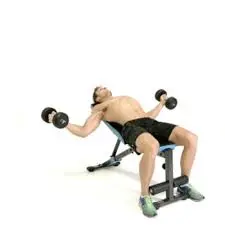
If you look back at the golden era of bodybuilding—the age of Arnold Schwarzenegger, Franco Columbu, and Robby Robinson—you will find that their chest training was built around a tool that has largely been forgotten in modern fitness culture. Today, we are obsessed with heavy pressing. We look at fitness data, track our one-rep maxes on the bench press, and measure our progress by how many plates we can jam onto a barbell or a Smith machine. We treat the chest purely as a pushing muscle, convinced that if we can just push more weight away from our bodies, our pectoral development will take care of itself.
But if you look at the chest development of those golden era legends, their chests didn’t just look thick; they looked wide, fully expanded, and deeply separated. Their chests had a distinct outer sweep that flowed into the shoulder joints and a deep line running down the middle of the sternum.
When asked how they built such iconic physiques, their answer was always the same: they flew.
      [ INCLINE PRESS ]                    [ INCLINE FLY ] • Multi-Joint Compound Press         • Single-Joint Isolated Fly • High Triceps & Shoulder Drive      • Complete Deactivation of Triceps • Linear Pushing Movement Path       • Semi-Circular Arced Arc of Motion • Focuses on Mid-Range Strength      • Targets the Fully Stretched Position
In our modern pursuit of heavy weights, we have cast aside the incline dumbbell fly as a “finisher” or a lightweight “toning” exercise. This is a profound mistake in physique architecture. While pressing movements are exceptional for loading the mid-range of a movement, they possess a distinct mechanical limitation: they fail to challenge the chest in its fully elongated position, and they allow the triceps and front shoulders to shoulder a massive portion of the load.
The incline dumbbell fly turns the tables. It is a single-joint isolation movement that strips away the triceps completely, forces the front shoulders into a stabilizing role, and applies intense, isolated mechanical tension to the clavicular head of the pectoralis major at its most vulnerable and responsive point: the fully stretched position.
If you are ready to stop simply pushing weight and start stretching your chest muscles into real growth, this comprehensive masterclass is your ultimate guide. We will break down the underlying biomechanics, map out flawless technical execution, eliminate the hidden joint-crushing mistakes, and detail advanced programming strategies designed to build an exceptional upper chest.
1. The Anatomy of the Stretch: The Biomechanics of the Fly
To understand why the incline dumbbell fly is indispensable for complete chest development, we must look past basic anatomy and analyze the relationship between muscle architecture and mechanical tension.
The Clavicular Head and Horizontal Adduction
As established in our structural principles, the chest muscle (pectoralis major) is divided into the lower sternocostal head and the upper clavicular head. The fibers of the upper chest originate along the inner half of your collarbone and run diagonally downward and outward to attach to your upper arm bone (humerus).
The primary functional duty of these upper fibers is horizontal adduction—the act of pulling your upper arm across the centerline of your body.
During a press, your arms move forward and upward in a straight line. During a fly, your arms move in a wide, sweeping arc. This semi-circular path forces your upper arm bone to travel through a much wider range of horizontal adduction. By opening the arms wide, you pull the insertion point of the muscle (on the arm) as far away from the origin point (on the collarbone) as anatomically possible, creating an incredible level of muscular elongation.
                         [ THE HORIZONTAL ARC ]                                       Origin: Inner Collarbone (Clavicle)                         /                                 /            <— Wide Sweeping Path                       /                                   v               v                 Left Arm           Right Arm               Fully Open           Fully Open
The Power of Stretch-Mediated Hypertrophy
For decades, lifters believed that the most important part of an exercise was the contraction—the “pump” or the hard squeeze at the top of a rep. However, modern sports science has completely shifted this paradigm, discovering a phenomenon known as stretch-mediated hypertrophy.
When a muscle is forced to produce force while fully stretched, it triggers a unique chain reaction within the muscle cells. The structural units of the muscle fiber, called sarcomeres, are pulled to their absolute limits. To protect itself from tearing, the muscle releases a massive surge of local anabolic hormones, such as Insulin-like Growth Factor 1 (IGF-1), and activates the mTOR pathway, which regulates muscle protein synthesis.
Exercises that load the muscle in its stretched position consistently yield greater muscle growth than exercises that only load the contracted position. The incline dumbbell fly is the undisputed king of loading the upper chest in this high-growth state.
2. Flawless Technical Execution: The Arc of Precision
Because the incline dumbbell fly places your arms far away from your body, it creates a massive amount of leverage against your shoulder joints. If you perform this exercise with sloppy form, you will place immense, dangerous stress on your rotator cuffs.
Follow this step-by-step blueprint to execute every repetition with perfect safety and precision.
Step 1: Setting the Angle and the Five-Point Base
Set your adjustable bench to a clean $30^circ$ incline. Sitting at a higher angle shifts the stress away from your upper chest and dumps it onto your front shoulders.
Pick up a pair of moderate dumbbells—never ego-lift on a fly—and sit back into the bench. Establish your five points of physical contact: plant both feet flat on the floor, anchor your glutes, pull your shoulder blades tightly together against the pad, and rest your head firmly against the bench.
                 [ THE 5-POINT FLY FOUNDATION ]                                              [Head]                              |                      [Scapulae Pulled Back]                              |                           [Glutes]                            /                         [Left Foot] [Right Foot]
Step 2: The Setup and Initial Lockout
Press the dumbbells straight up over your chest as if you are completing a standard dumbbell press. Once at the top, rotate your wrists so your palms face each other completely (a neutral grip).
Before you begin the movement, unlock your elbows. Bend your arms slightly to roughly a $15^circ$ to $20^circ$ angle. Lock your elbows into this exact slightly bent position; they must remain frozen at this angle throughout the entire repetition. Squeeze the dumbbell handles tightly to stabilize your wrists.
Step 3: The Wide, Sweeping Descent
Inhale deeply into your core, brace your abdomen, and begin opening your arms wide out to the sides in a slow, controlled arc.
- The Key Cue: Do not think about lowering the weights down. Instead, imagine trying to push the dumbbells out as far away from your body as possible, as if you are trying to touch the walls on either side of the room.
- The Elbow Path: Keep your elbows pointed down toward the floor throughout the entire descent. Your hands, wrists, and elbows should travel along the exact same horizontal plane, aligned perfectly with your upper chest.

Step 4: The Safe Bottom Stretch
Continue lowering the weights out to the sides until your upper arms are perfectly parallel to the floor, or slightly below it if you possess exceptional shoulder mobility.
At the bottom of the rep, the inside edges of the dumbbells should be positioned wide outside your chest line. You should feel a deep, intense stretch across your upper chest, right below your collarbones. Hold this fully stretched position for one clear second to eliminate momentum and maximize stretch-mediated tension.
       [ THE BOTTOM STRETCH CHECKPOINT ]                 INCORRECT:            CORRECT:          (DB) (DB)           (DB)              (DB)              /                               /           [Chest]               ____ [Chest] __/        • Too Narrow            • Wide, Deep Stretch        • No Isolation          • Complete Pec Elongation
Step 5: The Hug-A-Tree Ascent
Exhale and reverse the movement, pulling the dumbbells back up along the exact same wide arc.
- The Core Cue: Do not think about pressing the weights up with your hands. Instead, visualize hugging a massive redwood tree. Focus on driving the insides of your elbows inward toward the center of your chest.
- The Finish Line: Stop the movement when the dumbbells are roughly six to eight inches apart, directly over your upper chest. Do not let the dumbbells touch or clank together at the top. Stopping just short of vertical keeps constant, continuous tension loaded on the upper chest fibers.
3. Common Pitfalls That Destroy Growth and Irritate Shoulders
Because the fly path places the shoulder joint in a vulnerable position, minor execution errors can lead to joint strain. Eliminate these three common mistakes:
1. The Disguised Press (The Elbow-Bending Fly)
When lifters grab dumbbells that are far too heavy, their body will instinctively try to make the movement easier. As they lower the weights, they will continue to bend their elbows, turning the wide fly into a standard neutral-grip dumbbell press.
[ Dumbbell Too Heavy ] —> [ Elbows Bend Past 90° ] —> [ Fly Turns Into A Press ] —> [ Loss of True Muscle Isolation ]
When they press the weight back up, they straighten their arms, using their triceps to complete the lift. This removes the unique benefit of the fly. If your elbow angle changes at all during the set, the weight is too heavy. Drop the load down and keep your elbow bend frozen.
2. Over-Stretching into Pain
Because the stretch is highly effective for muscle growth, many lifters assume that more stretch is always better. They will lower the dumbbells as deep as possible, forcing their hands far below the level of the bench pad.
If you drop past your natural structural range of motion, the mechanical tension shifts entirely off the chest muscle and tears into the delicate anterior capsule of the shoulder joint and the bicep tendons. Lower the dumbbells until your upper arms are parallel to the floor—this provides a complete muscular stretch without risking a structural injury.
3. The Shoulder-Rounding Collapse
As the weights travel to the bottom of the fly, your body will naturally try to relieve the tension on the chest by allowing your shoulder blades to un-pack and roll forward off the bench pad.
The moment your shoulders roll forward, you lose your structural base, your chest collapses, and your front deltoids take on the burden of the weight. Keep your shoulder blades pinned back and driven down into the bench throughout the entire movement. Your chest must remain held high, acting as a proud platform for the dumbbells to stretch across.
4. Advanced Strategic Variations
Once you have mastered the standard incline dumbbell fly, you can introduce these specialized variations to spark new muscle growth and overcome plateaus.
1. The Incline Pronated Dumbbell Fly (The True Upper Peak)
Set up exactly like a standard incline fly, but instead of using a neutral grip where your palms face each other, rotate your wrists so your palms face forward (a pronated grip) throughout the entire set.
       [ PALM ROTATION VARIATION ]               Standard Neutral:     Pronated Variation:           ( | ) ( | )           ( — ) ( — )        Palms Face Inward      Palms Face Forward
This grip modification changes the internal rotation of the humerus bone, aligning the movement line with the fibers of the clavicular head. It provides a unique contraction at the top of the arc, making it an excellent variation for lifters looking to maximize mind-muscle connection.
2. The Stretch-Iso-Hold Fly (Density Training)
Select a pair of dumbbells that is roughly 20% lighter than your usual work weight. Perform a standard incline fly, lowering the weights into a wide, deep stretch.
Once you reach the bottom position, hold the weights statically for 5 continuous seconds while breathing deeply. After the 5-second hold, fly the weights back to the top, and repeat for a set of 6 to 8 reps. This extended isometric hold maximizes stretch-mediated muscle remodeling.
3. The Cable-Assisted Incline Dumbbell Fly
Place an adjustable incline bench directly in the center of a cable crossover station. Set the cables to the lowest position. Grab the handles, lie back on the bench, and perform your incline flyes against the cables.
While standard dumbbells provide great tension at the bottom of a fly, they lose all tension at the top because gravity pushes the weight straight down. Cables provide a continuous line of lateral pull, ensuring your upper chest experiences intense, continuous tension from the absolute bottom stretch all the way to the peak contraction at the top.
5. The Isolated High-Density Upper Chest Blueprint
Incorporate this high-performance isolation routine into your training split once or twice a week, placing it after your heavy compound pressing work to push your upper chest to absolute failure.
The Upper Chest Isolation Protocol
| Exercise | Sets | Reps | Tempo | Rest |
| $30^circ$ Incline Barbell Bench Press | 3 | 6–8 | 3-0-1-0 | 3 Min |
| Protocol Note: Use this heavy compound press first to prime your nervous system and load raw strength. | ||||
| Incline Dumbbell Fly (Neutral Grip) | 4 | 10–12 | 3-1-1-1 | 75 Sec |
| Protocol Note: Freeze your elbow angle; hold the bottom stretch for 1 full second on every rep. | ||||
| Stretch-Iso-Hold Incline Fly | 3 | 6–8 | 5-Second Hold | 60 Sec |
| Protocol Note: Drop the weight down; hold the absolute bottom position for 5 seconds per rep. | ||||
| Low-to-High Cable Flyes | 3 | 15 | 2-0-1-2 | 45 Sec |
| Protocol Note: Focus on a hard 2-second squeeze at the top, driving your biceps together. |
- Understanding the Tempo Code: 3-1-1-1 = 3-second negative lowering phase, 1-second pause in the stretched position, 1-second upward fly arc, and a 1-second squeeze at the peak before starting the next rep.
6. Prehab, Mobility, and Postural Balancing
Because the incline dumbbell fly forces your chest into a deep stretch, maintaining optimal flexibility in your chest muscles and upper spine is essential for executing the movement safely.
The Passive Foam Roller Chest Opener
To counteract the tight, rounded shoulders caused by heavy training and desk work, lie down lengthwise on a high-density foam roller so it supports your spine from your head down to your hips.
      [ PASSIVE CHEST OPENER ]                    [Head Supported]                │              [Foam Roller Lengthwise] ──► Arms Hang Wide Out to Sides                │                        (Passive Gravity Stretch)             [Hips Supported]
Open your arms wide out to the sides with your elbows slightly bent, letting your hands hang down toward the floor. Relax your body and breathe deeply for 2 minutes, allowing gravity to gently stretch your pectoralis minor and open up your chest frame.
The Rotator Cuff Face Pull
To ensure your shoulder joints remain stable under the high-leverage forces of the fly, perform 3 sets of 15 face pulls at the end of every chest workout. Grab a rope attachment on a cable machine, pull the center toward your nose, and flare your hands outward to strengthen your external rotators and upper back muscles.
7. The Final Contraction
Building a complete, well-proportioned physique requires looking past basic power and embracing pure muscular isolation. While pressing movements will always be your primary tool for building overall torso thickness, the incline dumbbell fly is the ultimate key to unlocking symmetrical upper chest width, deep separation, and complete muscle fiber recruitment.
Approach the exercise with discipline. Leave your ego behind, select a smart $30^circ$ angle, lock your elbows into a rigid arc, and focus on stretching your muscles through a controlled range of motion. By mastering the mechanics of the incline fly, you will eliminate structural imbalances, protect your shoulder joints, and build an exceptional upper chest that rounds out your physique.