

If you’ve ever rolled up your sleeves and wanted to look strong without throwing a single punch, you know the power of thick, muscular forearms. Well-developed biceps and shoulders command respect, but dense, vascular forearms are the ultimate sign of raw, practical strength.
Yet, for reasons that boggle the mind, lower arms are routinely ignored in most workout splits. Lifters spend hours grinding out chest presses and heavy curls, simply assuming their forearms will grow from holding dumbbells. But when heavy deadlifts start slipping out of your fingers or your upper arms dwarf your lower arms, the hard truth becomes clear: you need direct, isolated forearm work.
While free-weight barbell and dumbbell wrist curls are classic staples, they have a major physical limitation: their resistance relies entirely on gravity. At the bottom and top of a free-weight rep, tension drops dramatically.
Enter the cable wrist curl.
By utilizing a pulley setup, cable wrist curls deliver constant, uninterrupted mechanical tension through every millimeter of the rep. This constant pull isolates the forearm flexors, reinforces delicate wrist joints, and builds a crushing grip.
This master guide covers the functional anatomy, step-by-step biomechanics, form nuances, common errors, workout programming, and injury prevention so you can master the cable wrist curl.
Forearm Anatomy: What Happens During a Cable Wrist Curl?
To build massive forearms, you have to understand the anatomical layout of your lower arm. The forearm contains over 20 small muscles divided into two main functional compartments: flexors (the underside/palm side) and extensors (the top/back side).
The cable wrist curl specifically isolates the anterior flexor compartment, which makes up roughly 60% of your total forearm mass.
The Key Target Muscles
- Flexor Carpi Radialis: Runs along the thumb side of the inner forearm. It flexes the wrist and assists in radial deviation (tilting the hand toward the thumb).
- Flexor Carpi Ulnaris: Positioned along the pinky side of the forearm. It provides thickness to the inner edge of the forearm and stabilizes the wrist under heavy loads.
- Palmaris Longus: A central muscle belly that flexes the wrist. (Note: Roughly 14% of the population naturally lacks this muscle, but its absence does not hinder strength or muscle growth).
- Flexor Digitorum Superficialis & Profundus: Deep muscles that flex your fingers. When you allow the cable bar to roll down to your fingertips at the bottom of a rep, these muscles contract intensely to curl the handle back into your palm.
When you train these muscles directly with cable wrist curls, you build density through the entire anterior forearm, creating a powerful taper from your elbow down to your wrist.

Step-by-Step Execution: Master Perfect Form
The most common reason lifters fail to see forearm growth from wrist curls is poor execution. Moving too fast or using momentum shifts tension away from the target muscles and subjects delicate wrist tendons to unnecessary strain.
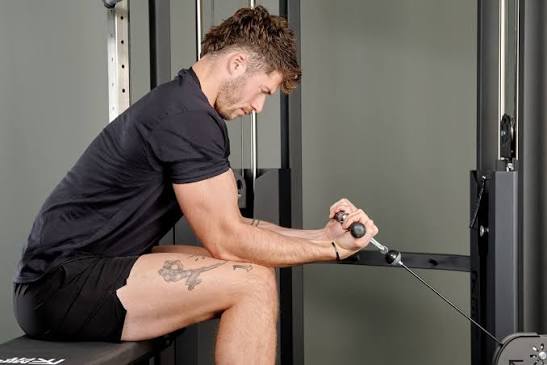
Here is the step-by-step protocol for the Seated Bench-Supported Cable Wrist Curl.1.Establish Your Base:Equipment & Bench Setup.
Set a low pulley cable machine to the bottom setting. Attach a straight bar or short revolver bar to the carabiner. Place a flat exercise bench parallel to or facing the cable stack, leaving roughly 1 to 2 feet of space.2.Anchor Your Forearms:Grip & Position.
Grab the bar with an underhand (supinated) grip, hands spaced shoulder-width apart. Sit firmly on the edge of the bench. Rest your forearms flat along your thighs or across the bench surface, positioning your wrists so they extend 2 to 3 inches past your knees or the bench edge.3.Lower & Open the Grip:Eccentric Stretch.
Inhale and slowly let the cable pull your wrists downward into extension over a 2- to 3-second tempo. At the deep stretch position, gently open your fingers to let the bar roll down toward your fingertips for a deep flexor stretch.4.Curl & Lock Out:Concentric Flexion.
Exhale and curl your fingers closed to pull the bar back into your palms, then flex your wrists upward as high as possible against the constant cable tension. Drive the handle upward without lifting your elbows or forearms off the support surface.5.Hold the Squeeze:Peak Contraction.
At peak flexion, pause for 1 to 2 full seconds. Squeeze your forearm flexors hard against the steady resistance before beginning the next rep.
The 5 Most Destructive Mistakes (and How to Fix Them)
If you aren’t feeling an intense, deep pump in your forearms during cable wrist curls, check for these five frequent mistakes:
1. Lifting the Forearms Off the Support
- The Error: Allowing your elbows or forearms to fly upward off your thighs or the bench as you curl the weight, turning the movement into a full arm curl.
- The Correction: Keep your forearms pressed firmly against the bench or thighs from start to finish. The only moving joint should be your wrist.
2. Going Too Heavy (Ego Lifting)
- The Error: Loading the weight stack with heavy plates that force you to jerk your body, cut the range of motion short, or strain your wrist tendons.
- The Correction: Start light. Forearms respond best to strict control, full range of motion, and high metabolic stress. Choose a weight you can strictly control for 12 to 20 reps.
3. Skipping the Finger Roll
- The Error: Keeping a rigid, tight grip on the handle through the entire set without allowing the bar to roll down to your fingertips at the bottom.
- The Correction: Uncurling your fingers at the bottom stretches the deep finger flexors (flexor digitorum), increasing total muscular stretch and triggering greater hypertrophy.
4. Standing Too Far or Too Close
- The Error: Positioning the bench too far from the pulley stack, causing the cable line of pull to pull your arms forward rather than down and back.
- The Correction: Position the bench so the cable wire forms a 45-to-60-degree angle relative to your forearms, maintaining direct perpendicular force against your wrists at peak lockout.
5. Rushing the Eccentric Phase
- The Error: Letting the cable snap your hands back rapidly at the end of each rep.
- The Correction: Resist the cable’s pull over a 2- to 3-second count. The eccentric phase under continuous tension builds muscle tissue and reinforces tendon strength.
Cable Wrist Curl Variations & Alternatives
Incorporating different angles and grips ensures balanced forearm development across both the flexors and extensors.
| Variation | Primary Target Area | Key Advantage | Recommended Attachment |
| Seated Cable Wrist Curl | Forearm Flexors | High stability, isolates flexors with constant tension | Straight Bar / Revolver Bar |
| Standing Behind-the-Back Cable Curl | Flexors & Grip Strength | Continuous tension at peak lockout behind lower back | Straight Bar |
| Reverse Cable Wrist Curl | Forearm Extensors & Brachioradialis | Balances wrist health, prevents joint imbalance | Straight Bar or EZ-Bar |
| Single-Arm Cable Wrist Curl | Unilateral Flexors | Corrects left-to-right strength & size imbalances | D-Handle Attachment |
Deep-Dive: Behind-the-Back Cable Wrist Curl
Standing behind-the-back cable wrist curls allow you to maintain continuous tension while standing upright.
- Setup: Attach a straight bar to a low pulley. Stand facing away from the cable stack and grab the bar behind your glutes with a shoulder-width overhand grip (palms facing backward).
- Execution: Take a step forward to elevate the weight stack. Allow the bar to roll down to your fingertips, then curl your fingers and flex your wrists upward behind your lower back. Squeeze at the top for a full second.
Workout Programming: How to Train Your Forearms
Because your forearms are used daily for gripping objects, they consist of a high percentage of Type I (slow-twitch) endurance muscle fibers. To force them to grow, you need high rep ranges, short rest intervals, and consistent frequency.
Option A: Complete Forearm Hypertrophy Routine
Perform this routine 2 times per week at the end of an Arm or Pull workout.
- Seated Cable Wrist Curls: 4 sets x 15–20 reps (2-second peak pause; Rest: 45s)
- Reverse Cable Wrist Curls: 3 sets x 15–20 reps (Rest: 45s)
- Behind-the-Back Cable Wrist Curls: 3 sets x 12–15 reps (Rest: 45s)
Option B: The “Crushing Grip” Power Routine
Focuses on building functional hand strength alongside flexor mass.
- Standing Behind-the-Back Cable Curls: 4 sets x 10–12 reps (Rest: 60s)
- Seated Cable Wrist Curls: 3 sets x 12–15 reps (Rest: 45s)
- Farmer’s Carries (Heavy Dumbbells or Kettlebells): 3 sets x 50 yards
Injury Prevention & Wrist Care
Because the wrist joint contains intricate tendons, ligaments, and nerves (including the median nerve passing through the carpal tunnel), prioritizing joint health is non-negotiable.
- Warm Up Thoroughly: Perform 2 to 3 warm-up sets with light cable resistance before moving to working weights.
- Avoid Painful Over-Extension: Never force your wrist into pain at the bottom of the stretch. Stretch to the limit of your natural mobility without pressing against joint discomfort.
- Balance Your Training: For every set of wrist curls (flexion), train your reverse wrist curls (extension) to maintain equal muscle balance across the wrist joint.
Frequently Asked Questions
Why are cable wrist curls better than barbell wrist curls?
Barbell wrist curls rely on gravity, meaning tension drops to zero at the bottom and top of the movement. Cables provide continuous mechanical tension throughout the entire arc, keeping your flexors loaded at every point of the rep.
How often should I perform cable wrist curls?
Forearms recover rapidly due to their high proportion of slow-twitch fibers. Direct forearm training 2 to 3 times per week yields optimal hypertrophy and strength gains without overtraining.
Can cable wrist curls help improve my deadlift grip?
Yes! Cable wrist curls strengthen your finger flexors (flexor digitorum profundus) and wrist flexors, directly increasing your ability to hold heavy barbells during deadlifts, rows, and pull-ups without your grip giving out.
Where would you like to take your forearm training next?
Compare Cable vs Barbell Wrist Curls
Get a complete Grip Strength & Forearm Guide
#CableWristCurls #ForearmWorkout #GripStrength #ArmDay #GymTips #Bodybuilding #StrengthTraining #ForearmFlexors #WorkoutRoutine #WeightLifting #PersonalTrainer #ExerciseForm #ForearmExercises #FitLife #UpperBodyWorkout #Hypertrophy #GymMotivation #ArmWorkout #FitnessJourney #FitnessGoals #CableWorkout #GymLife #FitTips #TrainingTips #PhysicalFitness #SportScience #PullDay #WorkoutMotivation #HomeGym #MuscleBuilding
