

If you have ever rolled up your sleeves and wanted to project immediate, unmistakable physical authority without speaking a word, you already know the unmatched impact of thick, dense, vascular forearms. Big biceps and wide shoulders command respect in a tank top, but granite-like forearms are the ultimate signature of raw, practical, real-world physical strength. They are fully visible in t-shirts, polo shirts, and rolled-up dress shirts alike.
Yet, lower arms remain one of the most routinely neglected muscle groups in modern fitness programming. Lifters spend hours grinding through heavy bench presses, lat pulldowns, and bicep curls, operating under the comfortable lie that their forearms will automatically blow up just from holding dumbbells and barbells.
Then reality hits hard:
- Your heavy deadlifts start slipping out of your fingers at lockout before your hamstrings or glutes even fatigue.
- Your upper arms completely dwarf your lower arms, creating an awkward, top-heavy aesthetic.
- Your wrists start aching during heavy bench presses or overhead presses because the surrounding tendons lack structural stability.
When these walls hit, the diagnosis is simple: you need direct, brutal, targeted forearm isolation.
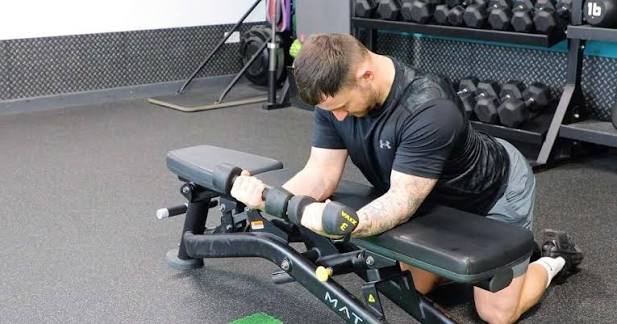
While specialized equipment like cables or wrist rollers are incredible tools, nothing beats the foundation of lower-arm mass building: the dumbbell bench wrist curl. By anchoring your forearms on a bench and using dumbbells, you can isolate each lower arm independently, eliminate strength and size asymmetries, and work through a deep, natural biomechanical range of motion.
Part 1: Deep Forearm Anatomy & Biomechanics
To trigger continuous muscle growth in your lower arms, you must stop treating the forearm as a single muscle. The human forearm is an intricate anatomical structure housing over 20 individual muscles divided into distinct functional compartments across three primary layers (superficial, intermediate, and deep).
These muscles cross multiple joints—including the elbow, radioulnar joints, wrist joint, and finger joints—meaning they perform far more than just simple wrist flexion.
1. The Anterior (Flexor) Compartment
Located on the palm side of your forearm, the flexor compartment accounts for roughly 60% of total lower arm volume. The dumbbell bench wrist curl specifically targets this region.
- Flexor Carpi Radialis (FCR): Originates at the medial epicondyle of the humerus (inner elbow) and runs down to the base of the second and third metacarpals (thumb side). It flexes the wrist and assists in radial deviation (bending the hand toward the thumb).
- Flexor Carpi Ulnaris (FCU): Runs along the outer pinky edge of the inner forearm. It provides thickness to the medial lower arm and stabilizes the wrist under massive axial loads.
- Flexor Digitorum Superficialis & Profundus: Deep, powerful muscles that run down into your digits. These muscles generate your crushing grip strength. When you allow a dumbbell to roll down into your fingertips at the bottom of a wrist curl, these deep flexors fire at maximum capacity.
- Palmaris Longus: A long, slender muscle sitting centrally between the FCR and FCU that assists in wrist flexion. (Note: Approximately 14% of humans are born without a palmaris longus in one or both arms, which has zero negative impact on overall strength or hypertrophy potential).

2. The Posterior (Extensor) Compartment
Running along the top/back side of your forearm, the extensor group is responsible for extending your wrist upward toward the back of your hand.
- Extensor Carpi Radialis Longus & Brevis: Positioned on the upper thumb-side of the outer forearm. These build the upper “ridge” of the forearm.
- Extensor Carpi Ulnaris: Sits along the pinky side of the posterior forearm, balancing the forces generated by the flexor carpi ulnaris.
- Extensor Digitorum: Opens the hand and extends the fingers.
Critical Training Rule: Neglecting the extensor compartment while heavily training the flexors creates severe structural imbalances. This pulls the wrist joint out of alignment, leading directly to chronic elbow issues like medial epicondylitis (Golfer’s Elbow) or lateral epicondylitis (Tennis Elbow).
3. The Lateral Compartment: Brachioradialis
The Brachioradialis originates on the lower humerus (upper arm) and crosses the elbow joint to insert onto the styloid process of the radius. Because it does not cross the wrist joint, wrist curls do not train the brachioradialis. It functions primarily as a powerful elbow flexor when your forearm is in a neutral (thumbs-up) or pronated (overhand) position, such as during hammer curls or reverse curls.
Part 2: The Unilateral Advantage—Dumbbells vs. Barbells
Why do many lifters experience superior growth, better muscle pumps, and fewer wrist aches when switching from barbell wrist curls to dumbbell bench wrist curls? The answer comes down to anatomical freedom and unilateral resistance.
1. Eliminating Bilateral Strength Asymmetries
When using a straight barbell, your dominant hand will naturally absorb 55% to 60% of the total load without you realizing it. Over months of training, this creates visible muscle size and strength imbalances between your left and right forearms. Dumbbells demand that each lower arm carry 100% of its workload independently, forcing your weaker arm to catch up.
2. Protecting the Carpal Joint
A straight barbell forces both wrists into a rigid, perfectly flat horizontal plane. However, most humans have a natural carrying angle at the wrist and elbow. Dumbbells allow your wrists to articulate naturally—tilting slightly into radial or ulnar deviation at the bottom of the movement—eliminating unnatural shear stress on the carpal tunnel and delicate ligaments.
3. Deeper Range of Motion at the Bottom Stretch
Because a barbell handle connects both hands, it limits how far your hands can flare outward at the bottom of the movement. With dumbbells, you can spread your fingers and let the weights roll deeper into your fingertips, achieving a far superior stretch on the flexor digitorum profundus.
Part 3: Step-by-Step Execution Mastery
To maximize growth and keep your wrist joints healthy, execution must be deliberate and strict. Moving too fast or incorporating body momentum shifts tension away from the forearm flexors and exposes delicate tendons to micro-trauma.
Here is the master protocol for the Seated Bench-Supported Dumbbell Wrist Curl.
1.Establish Your Base:Bench & Grip Setup.
Grab a pair of light to moderate dumbbells. Kneel beside or straddle a flat exercise bench. Rest your forearms flat along the padded bench, palms facing up (supinated), with your wrists extending 2 to 3 inches past the bench edge.
2.Lower into the Deep Stretch:Eccentric Stretch & Finger Roll.
Inhale deep into your diaphragm. Slowly lower the dumbbells toward the floor over a controlled 3-second tempo. At the bottom of the movement, gently uncurl your fingers to let the dumbbell handles roll down toward your fingertips for a maximum flexor stretch.
3.Close Grip & Curl Upward:Concentric Curl.
Exhale and curl your fingers closed, rolling the dumbbell handles securely back into your palms. Next, flex your wrists upward toward the ceiling as high as your natural flexibility allows without letting your forearms or elbows lift off the bench.
4.Hold & Squeeze:Peak Contraction.
Hold the fully flexed top position for a 1 to 2-second peak pause. Actively flex your inner forearms as hard as possible before starting the next lowering phase.
Part 4: Technical Variations & Grip Tweaks
To ensure complete lower arm development, incorporate these key dumbbell variations into your routine.
1. Seated Dumbbell Reverse Wrist Curls (Overhand / Pronated)
- Setup: Rest your forearms flat on the bench with your palms facing downward toward the floor.
- Execution: Lower the dumbbells into wrist flexion, then extend your wrists upward toward the ceiling as high as possible.
- Target: Exclusively isolates the extensor compartment (extensor carpi radialis and ulnaris), building top-side forearm thickness and protecting against elbow pain.
2. Single-Arm Off-Bench Wrist Curls
- Setup: Sit on a bench, holding one dumbbell. Rest your working forearm along your thigh, with your wrist extending just past your knee.
- Execution: Perform the wrist curl unilaterally while using your non-working hand to brace your working elbow down against your leg.
- Target: Provides maximum mind-muscle connection and hyper-isolation for lagging arms.
3. Neutral-Grip Dumbbell Wrist Rotations (Pronation/Supination)
- Setup: Hold a light dumbbell by its end (or use a hammer) with your forearm resting on the bench.
- Execution: Rotate your wrist smoothly from palms-up (supination) to palms-down (pronation) in a controlled arc.
- Target: Strengthens the pronator teres and supinator muscles, building structural resilience for heavy lifting.
Part 5: The 7 Deadliest Mistakes in Dumbbell Wrist Curling
Avoid these common technical errors to ensure rapid growth and joint longevity:
1. Allowing Forearms or Elbows to Lift
- The Problem: Lifting your forearms or elbows off the bench padding turns the movement into a cheating arm curl, taking tension directly off the wrist flexors.
- The Fix: Glue your forearms to the bench. The only moving joint should be your wrist.
2. Skipping the Finger Extension Phase
- The Problem: Keeping a rigid, tight grip on the dumbbell handle throughout the set without letting it roll down into your fingers.
- The Fix: Uncurling your fingers at the bottom stretches the deep finger flexors (flexor digitorum), maximizing total muscular tension and building superior grip power.
3. Excessive Ego Loading
- The Problem: Grabbing 40–50 lb dumbbells that force you to jerk your torso and cut the range of motion to tiny 1-inch twitches.
- The Fix: Leave your ego at the door. Forearms respond best to strict control, high rep ranges (12–25 reps), long time-under-tension, and short rest periods.
4. Rushing the Eccentric Phase
- The Problem: Letting the dumbbells drop rapidly at the bottom of each rep.
- The Fix: Lower the dumbbells over a slow 3-second count. The eccentric phase under load builds muscle tissue and reinforces tendon strength.
5. Neglecting Extensor Balance
- The Problem: Exclusively training underhand flexor curls while ignoring overhand extensor curls.
- The Fix: Pair every set of underhand wrist curls with a set of overhand reverse wrist curls to maintain equal strength across the wrist joint.
6. Moving Too Fast Through Reps
- The Problem: Bouncing weights rapidly without pausing at peak contraction or stretch.
- The Fix: Implement a strict tempo cadence: 3 seconds eccentric, 1 second stretch, 1 second concentric, 2 seconds peak contraction.
7. Training Forearms First in a Workout
- The Problem: Fatiguing your forearms and grip before doing heavy deadlifts, pull-ups, or back rows.
- The Fix: Always train your forearms at the very end of your workout session.
Part 6: Comprehensive Comparison Matrix
| Exercise Factor | Dumbbell Bench Wrist Curl | Cable Wrist Curl | Wrist Roller | Barbell Wrist Curl |
| Primary Muscle Hit | Inner Flexors (FCR, FCU) | Inner Flexors (FCR, FCU) | Flexors OR Extensors | Inner Flexors (FCR, FCU) |
| Unilateral Isolation | Yes (100% Independent) | Optional (with D-Handles) | No | No |
| Joint Freedom | High (Natural Rotation) | Moderate | Moderate | Low (Fixed Bar Angle) |
| Tension Profile | High in middle & bottom | Continuous & Smooth | Continuous & Increasing | High in middle, drops at ends |
| Equipment Access | Universal (Every Gym/Home) | Requires Cable Stack | Requires Roller Attachment | Requires Barbell |
| Hypertrophy Rating | 9.5 / 10 | 9.5 / 10 | 10 / 10 | 7.5 / 10 |
Part 7: Science-Backed Workout Protocols
Because your forearms are engaged in daily activities like opening doors and holding objects, they contain a high percentage of Type I (slow-twitch) fatigue-resistant muscle fibers. To force them to grow, you must subject them to high volume, high rep ranges, high metabolic stress, and short rest intervals.
Protocol A: The “Forearm Density” Mass Workout
Perform this routine twice per week at the conclusion of your Pull or Arm workouts.
- Seated Dumbbell Bench Wrist Curls (Underhand): 4 sets x 15–20 reps (Tempo: 3-1-1-2; Rest: 45s)
- Seated Dumbbell Bench Reverse Wrist Curls (Overhand): 3 sets x 15–20 reps (Tempo: 2-0-1-1; Rest: 45s)
- Standing Dumbbell Hammer Curls: 3 sets x 10–12 reps (Targets Brachioradialis; Rest: 60s)
- Single-Arm Dumbbell Farmer’s Carries: 3 sets x 40 yards per arm (Rest: 60s)
Protocol B: The “Crushing Grip” Home Gym Routine
Requires only a pair of dumbbells and a flat bench or chair.
- Single-Arm Off-Leg Dumbbell Wrist Curls: 4 sets x 12–15 reps (Rest: 45s per arm)
- Dumbbell Reverse Wrist Curls: 3 sets x 15–20 reps (Rest: 45s)
- Dumbbell Wrist Rotations (Pronation/Supination): 3 sets x 12 reps per direction (Rest: 45s)
- Timed Dumbbell Head Pinch Holds: 3 sets to absolute failure (Gripping the head of a heavy dumbbell)
Part 8: Injury Prevention & Joint Preservation
Because the wrist joint is a complex assembly of small carpal bones, delicate nerves (including the median nerve passing through the carpal tunnel), and dense tendons, joint health is crucial.
1. Warm-Up Protocols
Never start heavy forearm training cold. Always perform 2 to 3 light warm-up sets of wrist circles, light rubber band finger extensions, and empty-hand wrist curls to flush synovial fluid into the wrist joints.
2. Manage Tendon Inflation
Muscles adapt to resistance faster than tendons and ligaments. While your forearm muscles might handle rapid weight increases, your tendons need weeks to adapt to heavy loading. Increase dumbbell resistance gradually in small increments.
3. Dedicated Mobility Work
At the end of every forearm session, perform static stretches:
- Prayer Stretch (Flexor Stretch): Place your palms together in front of your chest with fingers pointing upward. Slowly lower your hands while keeping your palms pressed together until you feel a deep stretch along the underside of your forearms. Hold for 30 seconds.
- Reverse Prayer Stretch (Extensor Stretch): Place the backs of your hands together in front of your chest with fingers pointing downward. Raise your elbows slightly to deepen the stretch along the top of your forearms. Hold for 30 seconds.
Part 9: Frequently Asked Questions
Are dumbbell wrist curls better than barbell wrist curls?
Yes. Dumbbells allow each wrist to move through its natural anatomical plane without being locked into a rigid barbell angle. They also prevent your dominant arm from compensating for a weaker arm, correcting side-to-side muscular imbalances.
How often should I train forearms with dumbbell wrist curls?
Because forearms contain a high proportion of slow-twitch, fatigue-resistant muscle fibers, they recover quickly. Training them 2 to 3 times per week at the end of your workouts yields optimal hypertrophy and strength gains without overtraining.
Will dumbbell wrist curls help improve my deadlift grip?
Yes. Dumbbell wrist curls strengthen your finger flexors (flexor digitorum profundus) and wrist flexors, directly increasing your ability to hold heavy barbells during deadlifts, rows, and pull-ups without your grip giving out.
#DumbbellWristCurls #ForearmWorkout #GripStrength #ArmDay #GymTips #Bodybuilding #StrengthTraining #ForearmFlexors #WorkoutRoutine #WeightLifting #PersonalTrainer #ExerciseForm #ForearmExercises #FitLife #UpperBodyWorkout #Hypertrophy #GymMotivation #ArmWorkout #FitnessJourney #FitnessGoals #DumbbellWorkout #GymLife #FitTips #TrainingTips #PhysicalFitness #SportScience #PullDay #WorkoutMotivation #HomeGym #MuscleBuilding
