

If you have spent months—or even years—knocking out set after set of bodyweight floor crunches, high-rep sit-ups, and hanging leg raises without seeing the deep 3D abdominal separation you want, you are suffering from a missing mechanical variable: progressive resistance overload.
Your abdominal muscles are Skeletal Muscles—built primarily of Type I (slow-twitch) and Type II (fast-twitch) muscle fibers in roughly a 50/50 ratio. Just like your chest, shoulders, or quads, the rectus abdominis will not undergo significant mechanical hypertrophy without being subjected to mechanical tension, extended ranges of motion under load, and systematic resistance progression.
The rope cable crunch is widely regarded by strength coaches, biomechanists, and professional bodybuilders as the single most effective weighted exercise for isolating and overloading the rectus abdominis.
By utilizing a high pulley machine, constant cable tension, and a flexible rope attachment, the kneeling rope crunch allows you to curl your ribcage toward your pelvis against direct adjustable resistance—all while neutralizing hip flexor momentum and protecting your lumbar spine.
Anatomy of the Kneeling Cable Crunch: Muscle activation in the rectus abdominis and supporting obliques. Source: Fitness Volt
Part 1: Comprehensive Anatomy & Biomechanics
To extract maximum growth from the rope cable crunch, you must understand the exact muscle architecture involved and how force vectors act upon your spine during flexion.
1. Rectus Abdominis (The Six-Pack Wall)
The rectus abdominis originates at the pubic crest and symphysis and inserts into the costal cartilages of ribs 5 through 7 and the xiphoid process of the sternum.
- Primary Function: Flexion of the lumbar and thoracic spine (bringing the sternum closer to the pelvis).
- Rope Crunch Activation: During a rope crunch, the line of pull from the overhead pulley perfectly matches the orientation of the rectus abdominis fibers. As you roll your spine into flexion, the muscle shortens forcefully against constant cable resistance.
2. Transverse Abdominis (TVA – The Core Vacuum)
The TVA lies deep beneath the rectus abdominis and acts as a natural lifting belt around your waist.
- Primary Function: Maintains intra-abdominal pressure (IAP), flattens the abdominal wall, and stabilizes the spine.
- Rope Crunch Activation: Exhaling completely at the peak of the crunch forces the TVA to contract, flattening your waistline under load and enhancing the contraction of the overlying rectus abdominis.
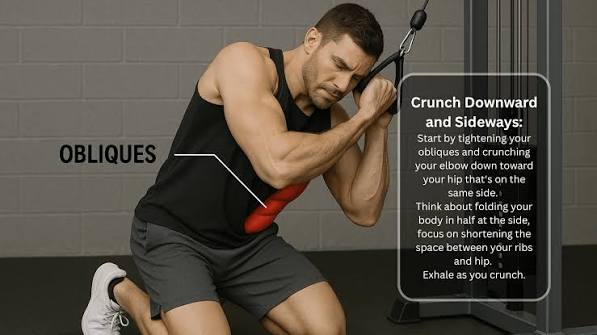
3. External & Internal Obliques
Located laterally on either side of the abdomen, the obliques run diagonally across your midsection.
- Primary Function: Torso rotation, lateral flexion, and anti-rotational stability.
- Rope Crunch Activation: In a standard straight-plane cable crunch, the obliques act as powerful stabilizers to keep your torso centered. When modified into an oblique cable crunch (crunching down toward alternating knees), they become primary dynamic movers.
Part 2: Why Cable Tension Outperforms Floor Crunches
The physics of core training dictate how much mechanical tension reaches your muscles. Here is how the rope cable crunch compares to traditional floor movements:
- Constant Resistance Across the Entire Arc: On a floor crunch, gravity only acts vertically. Once your upper back is slightly elevated, the resistance drops off significantly. A cable machine provides a consistent diagonal vector, keeping full tension on your abs from full spinal extension to maximum peak flexion.
- Elimination of Hip Flexor Takeover: When doing sit-ups with anchored feet, the psoas major pulls heavily on your lumbar vertebrae to pull your whole upper body upward. On a kneeling cable crunch, your knees remain stationary at a 90-degree angle, locking your hips in place so your abs perform 100% of the work.
- Scalable Progressive Overload: Bodyweight crunches force you to add higher and higher reps once you get stronger, which builds muscular endurance rather than thickness. With a cable machine, you can simply adjust the weight pin by 5 lbs to keep driving hypertrophy in the optimal 8 to 15 rep range.
Strict Kneeling Execution: Notice the fixed 90-degree hip angle and full spinal rounding at the bottom. Source: Hevy app
Part 3: Step-by-Step Form & Execution Protocol
Executing the rope cable crunch with exact form is critical to avoid turning it into a arms-and-lats pulling movement.1.Position Your Base:Set Up the Pulley & Kneeling Base.
Set the cable pulley to its top setting and attach a standard double-rope handle. Kneel on a padded mat roughly 2 to 3 feet in front of the cable stack facing away from or toward the machine. Position your knees shoulder-width apart for a sturdy foundation.2.Lock Your Upper Body Unit:Anchor the Hands to the Head.
Grasp the rope ends with a neutral grip. Pull the cable down until your hands are anchored securely against the sides of your head (thumbs resting near your jawline or temples). Lock your arms in this exact position—they must remain frozen throughout the entire set.3.Curl from the Ribcage:Initiate Thoracic Flexion.
Inhale deeply, then exhale forcefully as you begin curling your upper spine downward. Focus on pulling your ribcage down toward your hips rather than pulling the rope down with your arms or sitting back onto your feet.4.Hold the Squeeze:Peak Abdominal Contraction.
Drive your elbows down toward your thighs or the floor until your spine is fully rounded. Pause at the bottom position for 1 to 2 full seconds, squeezing your abs hard while blowing out any remaining air from your lungs.5.Unroll Under Tension:Controlled Eccentric Lowering.
Inhale and slowly unroll your spine back up to the starting position over a deliberate 2- to 3-second tempo. Allow your abs to stretch fully at the top without letting the weight stack touch down.
Part 4: Advanced Variations & Progressions
Once you master the standard kneeling rope crunch, incorporate these advanced variations to hit your midsection from different angles:
1. Kneeling Oblique Cable Crunch
- Execution: As you flex your spine downward, rotate your torso slightly to drive your right elbow toward your left knee. Alternate sides with each rep or complete a full set on one side before switching.
- Target: Heavily targets the internal and external obliques alongside the upper abdominal wall.
2. Standing Rope Cable Crunch
- Execution: Stand facing away from a high cable pulley, hold the rope attachment against your neck/shoulders, and flex your upper spine forward while keeping your hips locked in space.
- Target: Excellent variation for lifters with knee sensitivity or those who prefer standing athletic stabilization work.
3. Decline Bench Cable Crunch
- Execution: Place a decline bench in front of the cable pulley machine. Anchor your legs on the bench, hold the rope overhead, and crunch upward against cable resistance.
- Target: Drastically expands the movement’s arc, giving your upper abs an intense stretch at the bottom of the rep.
Part 5: The 6 Common Mistakes (and Fixes)
Avoid these technical pitfalls to keep the tension on your abdominal wall:
1. Sitting Back onto Your Heels (The Hip-Hinge Mistake)
- The Error: Dropping your butt down onto your feet as you descend, turning the exercise into a bodyweight hip hinge.
- The Correction: Keep your hips locked at approximately 90 degrees directly above your knees throughout the entire set. Your lower body should remain completely stationary.
2. Pulling with the Triceps and Lats
- The Error: Extending your arms at the elbows or pulling the rope down using your lat muscles.
- The Correction: Lock your hands against your temples or jaw. Imagine your arms are unyielding hooks—all movement must come from bending your upper spine.
3. Keeping a Flat, Rigid Back
- The Error: Bending at the hips with a flat spine, as if doing a squat or deadlift.
- The Correction: The rectus abdominis flexes the spine. You must round your upper and mid-back as you crunch down to fully shorten and contract your abs.
4. Neck Jerking and Tucking
- The Error: Pulling your head down aggressively or tucking your chin violently into your chest.
- The Correction: Keep your head and neck aligned naturally with your upper torso. Maintain a fist-sized gap between your chin and collarbone.
5. Going Too Heavy (Sacrificing Range of Motion)
- The Error: Loading the entire weight stack and doing partial quarter-reps using body momentum.
- The Correction: Lower the weight until you can complete 12 to 15 full-range reps with a 2-second hold at peak contraction.
6. Rushing the Eccentric Lowering Phase
- The Error: Letting the weight stack yank your upper body back up rapidly after every rep.
- The Correction: Resisting the weight stack on the way back up drives major hypertrophy. Control the return over a slow 2- to 3-second count.
Part 6: Full Core Hypertrophy Workout Routines
Routine A: The “Progressive Overload” Ab Mass Program
Perform this routine twice per week at the end of your chest or back sessions.
- Rope Cable Crunches: 4 sets x 10–12 reps (Tempo: 3-1-1-2; Rest: 60s)
- Hanging Straight-Leg Raises: 3 sets x 10–15 reps (Rest: 45s)
- Cable Pallof Press: 3 sets x 12 reps per side (Anti-rotation focus; Rest: 45s)
- Bodyweight Vacuum Holds: 3 sets x 20-second holds (Rest: 30s)
Routine B: The “High-Density Core” Circuit
Perform as a continuous circuit with minimal rest between movements.
- Rope Cable Crunches: 3 sets x 15 reps
- Oblique Cable Crunches: 3 sets x 12 reps per side
- Ab Wheel Rollouts: 3 sets x 10–12 reps
- Plank Holds: 3 sets x 60 seconds (Rest 90 seconds between full rounds; repeat 3 times)
Part 7: Frequently Asked Questions
What is the best weight stack load for rope cable crunches?
Use a weight that lets you perform 10 to 15 strict reps with a full spinal extension at the top and a 2-second squeeze at the bottom. If your knees or feet float off the floor during the set, the weight is too heavy.
Should I face toward or away from the cable machine?
Facing away from the cable machine is generally superior because the cable path pulls over your shoulders without interfering with your face, allowing a cleaner line of pull during spinal flexion.
Will weighted rope crunches widen my waistline?
No. The rectus abdominis grows outward in thick, defined blocks rather than widening your hips. As long as your body fat percentage remains low, building thicker abdominal muscles improves core depth and aesthetics without making your waist look thick.
Where would you like to take your core training next?
Compare Cable Crunches vs Hanging Leg Raises
Build a Full Progressive Overload Core Program
#RopeCrunch #CableCrunch #AbWorkout #CoreTraining #SixPackAbs #FitnessGoals #GymMotivation #Bodybuilding #StrengthTraining #Calisthenics #AbDay #ExerciseForm #PersonalTrainer #FitTips #HomeWorkout #CoreStrength #FitnessJourney #WorkoutRoutine #WeightLifting #FitLife #UpperAbs #GymLife #TrainingTips #AbExercises #CoreStability #WorkoutMotivation #MuscleBuilding #ProgressiveOverload #FitnessLifestyle #GymAddict
